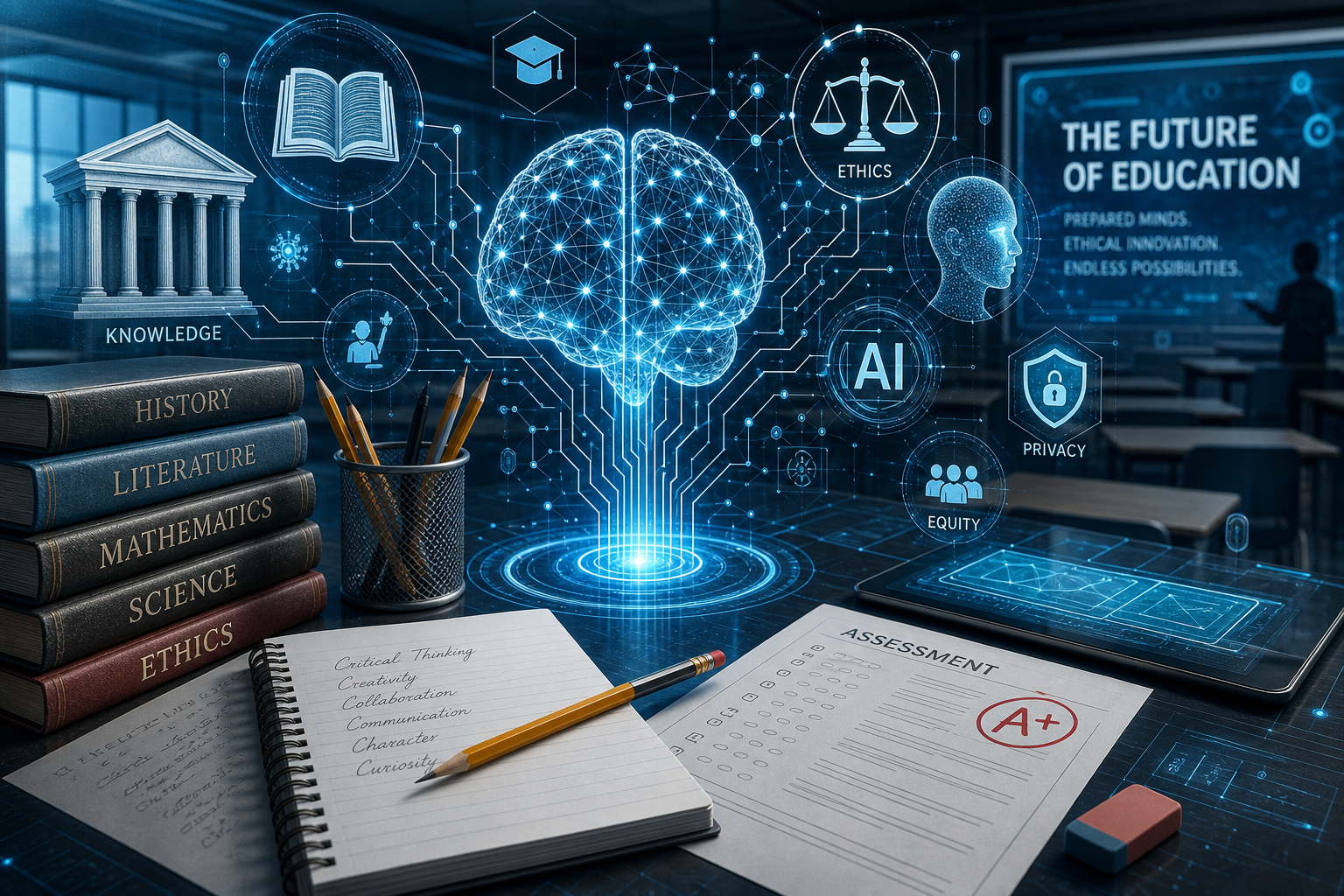
As artificial intelligence reshapes every aspect of our lives, education finds itself at a pivotal point. Traditional methods of student assessment, once considered robust, now face the challenge of staying relevant in an AI-driven environment. It's no longer a question of whether AI will influence education, but rather how we can harness its potential to enhance learning while maintaining academic integrity.
Embracing AI in Education
Artificial intelligence offers unprecedented opportunities to personalize learning experiences. By analyzing vast amounts of data, AI tools can identify student strengths and weaknesses, providing tailored feedback that helps educators support individual learning paths. For instance, platforms like DreamBox and Knewton employ adaptive learning technologies, which are designed to offer tailored educational experiences. Although these systems use sophisticated algorithms, the specific claim about adjusting question difficulty with AI needs precise verification from their official sources.
However, integrating AI in education raises significant questions about assessment. How do we ensure that AI doesn't inadvertently compromise academic integrity? The temptation for students to rely on AI-generated responses is high, especially when tools like GPT-4 can produce essays that mimic human writing. While GPT-4 can generate human-like text, its quality and indistinguishability from human writing depend heavily on the input and context. This reality requires a reevaluation of assessment methods, focusing on skills that AI cannot easily replicate.
Rethinking Traditional Assessment Methods
With AI's capabilities in mind, educators must explore innovative approaches to assessment that go beyond rote memorization and standardized testing. Project-based assessments, for example, encourage critical thinking, creativity, and problem-solving, skills that remain uniquely human. These projects can be designed to incorporate AI tools, allowing students to leverage technology while demonstrating their understanding and application of concepts.
Another promising approach is the use of open-book exams. By allowing students to access information during assessments, educators can shift the focus from memorizing facts to understanding concepts and applying knowledge in real-world scenarios. This method not only aligns with the skills demanded by the modern workforce but also reduces the incentive for academic dishonesty.
Ensuring Academic Integrity in the AI Age
Maintaining academic integrity in an AI-dominated era demands a multifaceted strategy. Educators must emphasize the value of original thought and ethical behavior from an early age. This can be reinforced through classroom discussions on the implications of using AI inappropriately and the importance of contributing one's own ideas.
Moreover, technology itself can aid in upholding integrity. Tools designed to detect AI-generated content, such as Turnitin's AI writing detection and OpenAI's AI classifier, are improving. However, their effectiveness can vary, and they are not yet fully reliable in all contexts. Studies have shown that while these tools are advancing, they still face challenges in consistently identifying AI-generated content, highlighting the need for continuous improvement and adaptation.
A Personal Take on the Future of Assessment
Reflecting on these challenges and opportunities, I see a future where assessment evolves into a more holistic process. One that values creativity, critical thinking, and ethical reasoning as much as technical knowledge. The goal should not be to outsmart AI but to work alongside it, equipping students with the skills they need to thrive in a world where AI is a constant companion.
It's a balancing act, no doubt. But the potential rewards are significant. Imagine a classroom where AI aids teachers in providing personalized learning experiences, while students grow into thinkers and innovators capable of navigating the complexities of the modern world. That's the vision we should strive for.
As we navigate this transition, one question lingers: How do we ensure that the integration of AI in education fosters not just smarter students, but also more empathetic and ethical individuals? The answer might just shape the future of learning for generations to come.